Early Modern Period: How dogs in paintings have changed and their symbolism... Or lack thereof.
In the Early Modern period, there was a shift in how dogs were used in art. Previously, dogs mainly represented evil acts or characteristics. Or even just evil dogs. During this time, though, artists really started to highlight the positive qualities of dogs. They were used to represent good human traits and experiences. It's interesting to not only note this change in focus, but to also think about why it occurred at this time. To be clear, this Early "Modern" period wasn't actually modern- the paintings we focus on in Simona Cohen's Dogs in the Religious Paintings of Tintoretto and Patrik Reuterswärd's The Dog in the Humanist's Study were actually based around the Renaissance time period. Perhaps the sudden flood of new ideas was what helped encourage this change in animal symbolism. Or perhaps it wasn't the 'new' ideas themselves, but the fact that people were starting to become more accepting of things they previously considered part of the devil's work. This change from rejection- and fear- to understanding is clearly represented in the shift of dog use in paintings. Just like how people were changing their perspectives, dogs were no longer shed in a superstitious and evil way but rather in a more positive light.
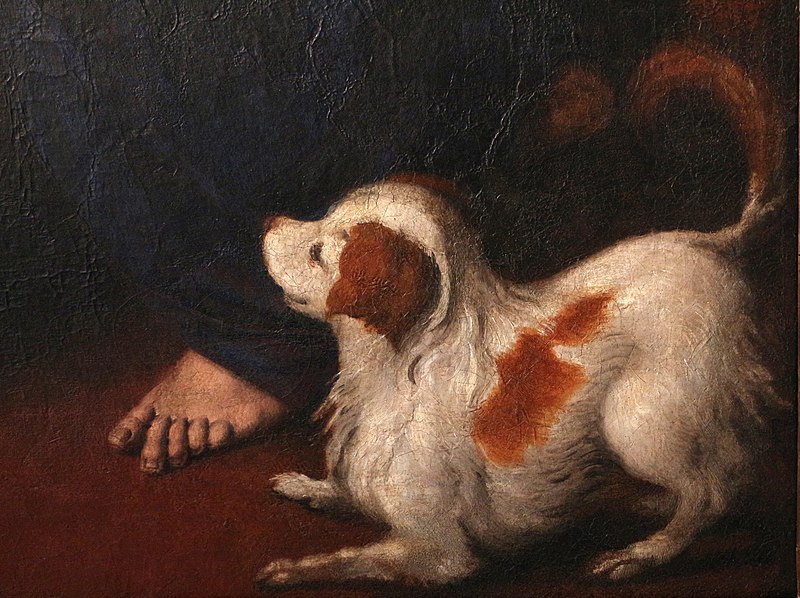
Image Source: Wikimedia Commons

There's a million and ten ideas as to why this shift in dog symbolism occurred, and what's even more interesting to think about is the concept that this new type of symbolism may not have been symbolism at all. In Simona Cohen's essay, they talk about how many people focus on the symbolism of dogs in individual paintings. They make it clear that they want to view this in a broader way, using all of Tintoretto's paintings to get a general idea as to what he was focusing on while using dogs as symbols. In the end, Cohen concludes that there isn't a specific trait or idea that Tintoretto focused on overall. Rather, he simply was breaking the prejudiced standards set by previous artists by presenting dogs in a more positive light in art. In other words, it wasn't what the individual dogs symbolized that was important in a broader context but rather the general idea that dogs can represent good things too.

Image Source: Wikimedia Commons

So now we have the idea that dogs can represent good things just like they can represent bad things. Wonderful, now we're looking at multiple perspectives and that can lead to a deeper and better understanding of the world around us. However, there's a third point of view that many of us dismiss in our constant search for figures and ideas to relate to; dogs are in paintings just to be there. Basically, this perspective focuses on the possibility that dogs exist in paintings simply because the artist wanted them there- there is no symbolism. It's a simple, clear answer and Reuterswärd gives us some easy to understand examples in their essay. So why did that child draw a yellow house? Well, simply because he wanted to. Does it have meaning? I don't think there's a two-year-old out there who would have an honest, deep philosophical answer to this so let's go with no. When we see that child's drawing as adults, we automatically start trying to dissect the reasoning behind all of the little artist's actions. We're so focused on finding they why, that it's difficult to accept that the answer may really be "Because."

Image Source: Pixino
I want to be clear with my opinion here; I'm not saying that all paintings, especially the paintings in the previously mentioned articles, don't have some symbolic meaning as to why the dog is included. In fact, I would say the vast majority do have meaning and that we should try to understand that symbolism. But we are often so intent on finding this meaning that we miss the far simpler and usually more obvious answers. Yes, this dog could represent the humility of this person and their struggle to overcome all of life's challenges. That dog, though, could also be there because that person really had a dog that was with them at the time shown in the picture. Or maybe the artist really liked dogs. Or maybe having some sort of creature companion in the painting just felt right. As adults, we're always searching for the reason behind other's actions and forget the more basic human instinct of just doing something because we want to. I think these essays do bring up a lot of wonderful examples of how dog symbolism were used in the Early Modern period, but they also bring up this point of a broader and simpler perspective. We can't truly dive deeper into an ocean of meaning without first touching the surface.
Comments
Post a Comment